Showing posts with label cost of living. Show all posts

Friday, May 6, 2022

Cost Of Living Philippines


Cost of Living in the Philippines

Here is a very good chart at Numbeo showing the costs of various items including costs of rent, electric, food, etc. in the Philippines (PH). Compare these to costs of living in the US.

In my experience I have found that, in the Philippines, a visit to a doctor in a clinic cost around P300 to P500. Overall. medical care in the Philippines costs about 10% the costs in the USA. Compare that to the "benefits" of a person who is "covered" by Medicare in the USA.

Now, when it comes to household electric bills, the cost is more than double our cost in Florida, USA (and that is comparing houses of the same size).

To repair an older car the cost will be far less than in the USA. 

It costs a lot less to date ladies of the PH. Average cost of a date in the US. New York City has the highest cost of a dinner date.

Cost of dinner for two in Manila.

Riding in taxis in Manila cost far less than a taxicab ride in Clearwater, Florida, USA.

Use the currency converter at this blog to compare to your home currency.


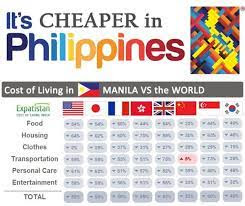
See the Expatistan cost of living site which has a great many items to compare to your home country.


Was this article helpful?


If you have found this article helpful, have suggestions, advice or insights please "comment" below.


This article will be expanded upon. Please check back for more information about cost of living in the Philippines. This page last updated June 3, 2022.

Saturday, June 13, 2015

Retire in the Philippines

retire in the Philippines


Retire in the Philippines!


There are about 300,000 Americans living full-time in the Philippines. Many, if not most, of them are retired. About 30,000 live in and around Angeles City on the island of Luzon.

The cost of living is much lower than in the USA. For example, the cost of a visit to a doctor or a dentist will be about $10 to $20. Medical and dental services are much cheaper.  In fact such services will cost from 5% to 10% of the price for the same services in the US.


We visited the Philippine Retirement Authority in Manila in 2019.


Rental rates:  We paid $70 a month rent for a
2 bedroom 1 bath apartment which had private parking with a gate in front of our first-floor unit. In the US the average cost of rent for a similar unit would be $1,205 a month (as of this date June 12, 2015.)

Cable TV and Internet service will cost about $20 a month each.

The cost of auto repair is significantly lower than in the US.

One can live comfortably on Social Security income of $800 or less a month. A family of 2 or 4 can live well on about $1,200 to $1,500 US a month. Of course it depends on where you live. If you live in a big city, like Manila, you can expect to pay considerably more for rent. But even there, a taxi will cost you only about $3.00 US to go about 5 or 10 miles. Living in more isolated places can lower your expenses considerably. I have read of families of 5 or more who live on $1,000 US a month or less.

There may be a way to engineer an extra, steady, income "by buying an immediate fixed annuity. According to ImmediateAnnuities.com, a 65 year old man who puts $100,000 into an immediate annuity today would collect about $500 a month throughout retirement."(from article 'Retire, Live Happily Ever After' in the Jan-Feb 2015 issue of Money magazine. Website: time.money.com)

If you are a Filipino you may want to check out e-PinoyGuide for information about Philippine Social Security benefits.

There are plenty of American fast food restaurant chains in the Philippines. Most are in the larger cities like Angeles City, Cagayan de Oro, Cebu, Davao, Manila and many more. You can find a good selection of American and European foods at grocery stores in the malls.

Shopping malls are world class! Visit a cinema in a mall and see first run movies for about $3.00 each. Get a haircut for a dollar or two. Your girlfriend or wife can get a manicure for a dollar or two.


Check out ladies of the Philippines. Many ladies are waiting for you. One good place to meet ladies is at food courts in the malls. Other places include beaches, churches, grocery stores, department stores, jeepneys, tricycles, buses and almost anywhere else.

It will  be a good idea to get travel insurance before you travel.

As for long term health insurance, there are many options, many health insurance providers in the Philippines.

Medicare will not cover you when you are abroad, but, 
I have heard that some Medicare insurance plans cover emergency medical care abroad. So be sure to check with your insurance agent.

You could fly back to the US if you should want to use  the services of the VA or use Medicare at other hospitals. There is a VA outpatient clinic in Manila and another on Guam. "Only Veterans who have a service connected disability of at least zero percent and registered with VA OPC are eligible for care and services (at the clinic in Manila.)"

Taken from the Manila VA outpatient website, "U.S. Veterans that live in another foreign country should coordinate their medical care and medication refills with the Foreign Medical Program (FMP.)"

As a foreigner you will not be permitted to work for remuneration in the Philippines unless you become a Permanent Resident and make application requesting to work there. You may not purchase a home unless you are married to a Filipino. You may, however, purchase a condo or lease a home.

Before you leave for the Philippines be sure you have a financial cushion. You will need to have money for deposits on cable, internet, water, electric, rental deposits, deposits before being admitted to hospitals, etc. and money for return flights to your home country. The more money you have in reserve the more comfortable you will be.

Oh, if you are a gambler there are a lot of casinos in the Philippines. It is possible to lose a lot of money. I have met Americans begging on the streets in Manila. The US Embassy will not give you money to fly back to the US and neither will the Philippine government. There are no free living quarters, no soup kitchens, so life could be extremely difficult if you lose your money.


You will need to extend your tourist visa regularly. Check with the US Embassy in Manila or with branch offices of the Embassy.  Don't overstay your visa, you could wind up detained by immigration. Be sure to extend your visa in a timely fashion each time it is required. Do not leave it to the last minute. Especially at holiday time. Immigration offices close for the holidays. I once had to book tickets online to leave the Philippines at the last minute, at a huge expense, because immigration was already closed when I had planned to go to renew. It was a good thing I managed to get that flight, immigration arrested about 20 foreigners, in the area where I had been living (Paranaque in Greater Manila), on or about Christmas day.

I spent 5 years living in the Philippines.


Check out US State Department site pages about travel to the Philippines.


What is the Philippine Retirement Authority?

 "The Philippine Retirement Authority (PRA) is a government owned and controlled corporation created by virtue of Executive Order No. 1037, signed by former President Ferdinand E. Marcos on 04 July 1985. On 31 August 2001, through Executive Order No. 26, the control and supervision of PRA was transferred to the Board of Investments (BOI) - Department of Trade and Industry from the Office of the President.


On 12 May 2009, Republic Act No. 9593, otherwise known as Tourism Act of 2009, PRA became an attached agency of the Department of Tourism and placed under the supervision  of the Secretary.
PRA is mandated to attract foreign nationals and former Filipino citizens to invest, reside and retire in the Philippines with the end-view of accelerating the socio-economic development of the country, contributing to the foreign currency reserve of the economy and by providing them the best quality of life in the most attractive package."

Special Resident Retiree Visa Program

"The SRRV allows all its foreign retiree-members to retire and live in the Philippines for as long as they want.  An SRRV holder may come in and out of the country as often as he desires, and enjoy privileges such as exemption from securing the ACR I-Card (Alien Certificate of Registration Immigration Card) from the Bureau of Immigration; exemption from paying the travel tax at the Philippine Airports; and exemption from getting a Study Permit or Student’s Visa for their dependent-children who intends to pursue education in the Philippines.  PRA retiree-members may also use health cards issued abroad in Philippine hospitals/clinics accredited by selected health card companies.  They may also avail of the one time tax-free importation of household goods/personal effects; and many more."

Top 10 Places To Retire In The Philippines according to ZipMatch. 


Was this article helpful?

If you have found this article helpful, have suggestions, advice or insights please "comment" below.


This post will be expanded. Check back for more information about retiring in the Philippines. Updated June 3 2022.

Friday, May 22, 2015

Are All Americans Rich?

Are all Americans Rich?
Are All Americans Rich? Are Filipinos Rich?

Are All Americans Rich In The Philippines?


Many Filipinos think that all Americans (US citizens) are rich. This is a misconception. The fact is that the true rate of unemployment in the US is about 23%. Average American household debt is $117, 951 US. 75% of Americans are living paycheck to paycheck. 25% of Americans have no savings at all. 36% of Americans rent the dwelling they and their families are living in. 64% own or are buying the dwelling they are living in and the average amount owed on their home mortgages is $95,000 US (from census data  2013). The average value of their homes is $160,000. See information about American Family Finances.

Many Filipinos think that Americans are rich. They see them visiting the Philippines and spending their money. Many of these Americans use their credit cards to fly to the Philippines and pay for hotels and other travel expenses. The average American has $2,200 US in credit card debt.

Rich Filipinos


See some statistics about "How rich is rich in the Philippines?"

Rude Awakening

 
When Filipinos arrive in the US they are in for a rude awakening. Rich or poor, they soon discover the high cost of living in the USA.

In the Philippines wealthy Filipinos can afford to hire the services of nannys, cooks and drivers.
In the USA only the super rich can afford such services. So, a Filipino who marries a US citizen and goes to live in the US can expect to do the laundry, do the cooking, wash the dishes and do the driving. Fortunately most families own a washing machine and a car.

True, wages are higher in the US but so is the cost of living. Visit my hospitals page to see examples of the cost of US hospital care compared to hospital care in the Philippines.


Was this article helpful?

If you have found this article helpful, have suggestions, advice or insights please "comment" below.


This post will be expanded. Check back for more information about wealth in the USA and in the Philippines, rich Americans and rich Filipinos. Last updated June 3, 2022.

Wednesday, May 16, 2012

American Expat in Philippines


Expat Blog Americans in the Philippines
Expat Blog About American Expat in the Philippines


American Expat Living in the Philippines

May 15, 2012

Woke up to another day in paradise. I love the Philippines.

Just told my lovely Filipino wife that I am starting this travel blog.

We met late in 2007 when I came to visit the Philippines. She was living in Paranaque City in the Metro Manila area. We married and now have a wonderful daughter.

We have traveled some in the Philippines and flew round trip to Singapore.


We have flown from Manila to Cebu City, Lapu Lapu, General Santos City and Cagayan de Oro. Have traveled by bus and / or traveled by jeepney to Tagaytay, Batangas, Laiya Beach, Subic City and Olongapo (in the Subic Bay Area), Bataan, Angeles City and San Fernando (in the province of Pampanga). We flew as tourists to Singapore.

We have eaten in almost every brand of American fast food restaurants in the Philippines.

We have stayed in several hotels, apartelles and pensiones in several cities on several islands.

The past President said that there are about 300,000 American expats living in the Philippines. Some of them are dual citizenship Filipinos who have moved back to the Philippines from the USA.
And, about 30,000 Americans live in and around Angeles City.

Living in Paranaque, Metro Manila, Philippines


Entrance to a compound and a squatter area, Paranaque City, Metro Manila
Entrance to compound where we lived for 2 years.

We lived for 2 years in the city of Paranaque in
Metro Manila in a 2-bedroom 1 bath dwelling of about 40 sq. meters or about 400 sq. feet. At times there were 8 family members residing there. The main room serves as kitchen, dining area and living room or "sala." We had TV and we had wireless internet via Smart Broadband. The family has "rights" to the dwelling (meaning there is no cost to live there.) It was crowded but enjoyable because of the warmhearted family members and neighbors. The compound consists of about 20 attached dwellings arranged in a rectangle around a central concrete "courtyard" of about 1,500 sq. feet. Children play there and women wash clothes and hang them on lines. The living units are single story with the exception of a couple which are 2 story units. Our daughter grew up here for the first 2 years of her life. She had plenty of kids to play with.

At times it would be very hot in the dwelling, temperatures often rose to 95F and even to 100F on really hot days. So fans were on constantly day and night. After about a year and a half we installed a ceiling (to separate the hot air space under the steel roof from our living area) and bought and installed a used air conditioner. That helped a lot, but it almost doubled the electric bill. In Metro Manila electricity cost about twice as much as in the USA.

Passenger jets taking off from Ninoy Aquino International Airport (NAIA) often fly over the compound. Makati City, the central business district of Manila, is only about 30 minutes away by either jeepney or taxicab. The cost of a taxi ride to Ayala's Glorietta Mall in the central business district of Makati City is around 130 pesos (about $2.90 US).

Nearby the compound where we were living is a very large "squatter" area consisting of hundreds of dwellings, mostly attached to each other. The sidewalk in the picture above goes through the compound and winds around and through the squatter area. Access to the dwellings in the squatter area is mainly via a matrix of concrete sidewalks, not roads. The dwellings there are mostly built of concrete blocks and have corrugated metal roofs. Most do not have air conditioning.

If you have the opportunity to live in a compound or a squatters' area don't pass it up. Live for a while like a great many Filipinos do. Get a real "feel" for the way most Filipinos live in the Philippines. It is an adventure. Use the dwelling as a base from which to explore other islands and other cities. From our compound we visited Tagaytay, Batangas, Bataan, Subic Bay, Olongapo and flew to General Santos City and Cagayan de Oro on the island of Mindanao. A couple of times we flew to Cebu. During our travels in the Philippines, we have stayed at all kinds of
hotels and apartelles.

Staying in a 4- or 5-star hotel you will never get a sense of what life is like for most Filipinos. And you will never get to really know the people.

Typhoon Gener and monsoon rains have caused heavy flooding during the last week of July and the first 2 weeks of August this year, 2012. I saw a cell phone video today, August 9, 2012, of our relatives walking back from the store on the street that leads to their house in Paranaque. Flooding has not been severe there. But, the water was almost up to their knees. Flooding did not reach their house. Half of Metro Manila is flooded as is Quezon City.
See dramatic photos of flooding.

While living in Metro Manila we traveled mainly by jeepney, tricycle and train. And occasionally by taxi and pedicab.

If you are going to visit Metro Manila area it would probably be best to plan your trip for the drier times of year. Typhoons are common June through October. But regardless the season people remain gracious.

The main reason not to stay in the big cities in the Philippines for very long is the air pollution.


Shoe shine in the Philippines.
Getting my shoes shined on a Sunday, across from a church in Paranaque.

Living in a Small Town in the Philippines

We lived another 2 years in a newer apartment in Magalang (near Angeles City) in the province of Pampanga.


Apartment living in Magalang, Pampanga, Philippines
Christmas 2010 at our apartment in Magalang (N. of Manila)

We leased an apartment we found online. In a newer building, of only 4 units, it was a ground floor 2 bedroom 1 bath unit of about 40 sq. meters (over 430 sq. ft.). Monthly rent was 3,500 pesos (or about $84 US @ an exchange rate of 43 pesos to a dollar) and included a gated car park in front of the unit. Try to find a rental rate like that in the USA! Rental rates for similar size and similar age apartments in the central area of Angeles City were about 12,000 to 20,000 pesos per month.

So, if you want an inexpensive apartment,
live in a rural area!

We had been advised by a Filipino friend and also by his policeman friend that it would be best to live in a "secure" subdivision or a "secure" building. Secure meaning with an armed security guard or guards.

However, we lived for almost 2 years in this rural apartment, in the town of Magalang, without security guards or incidents. We drove an old car and made friends with the local tricycle drivers and our neighbors.

The worst thing about the place we were living was that it was near pig farms. Check out my article about pig farms and chicken farms in the Philippines. Before you buy or lease a residence be sure to search for pig and chicken farms via Google earth, you may download it for free. Do not rent or buy a house near a pig or chicken farm!

Pickpockets, Crime and Security in the Philippines


Armed guards at shopping malls in the Philippines
Armed Security Guards check bags at most malls we have visited.
We always feel safe in the malls. We have never seen an incident.

In the Philippines all foreigners are called "Americans." Don't ask me why, I don't know.
All "Americans" are considered "rich." So whether you dress well or dress down you are still seen to be "rich." When traveling via jeepney, tricycle or bus always be cautious. The US Dept. of State issues travel advisories. In an advisory in 2011 it advised travelers to the Philippines not to ride on motorcycles, tricycles, jeepneys, buses or trains. The advice was to use only metered taxis. However, taxis are hardly ever found outside major metropolitan areas. We traveled, without harm, for over 5 years using all available modes of transportation.

Beware of pickpockets, especially when riding in jeepneys. Read my post about my run ins with thieves titled "Pick pockets in the Philippines. Crime in the Philippines."

Cost of living in the Philippines

The costs of living for foreigners may be considerably higher than for locals, depending on where you live and the lifestyle you choose. If you want to live more like a Filipino your costs can be very low. Read about wages in the Philippines.

Before I came to the Philippines I had read stories about how expats were living, with a wife and kids, for as low as 20,000 Pesos a month. I do not know how they do it. The only way I can imagine is that they are living in a province, away from major cities and are eating a Filipino diet of rice, fish, pork, coconut, and other local foods. I heard that one can buy a fresh 1 to 5 pound fish, just caught, for about 25 pesos from a young fisherman in provinces away from the major cities. My expenses, for our family of 3, were a minimum of 40,000 Pesos a month. This included rent (3,500 Pesos a month), electric, water, groceries, and some meals out in fast food restaurants like McDonalds, Jolibee, KFC and other American "restaurants" found in the Philippines. We also purchased some foods at grocery stores that featured imported American foods. Add in the numerous visits to doctors and hospitals and the cost can easily go up to 60,000 Pesos a month or higher. Read about our experiences at hospitals in the Philippines.

Visit this currency converter to convert Pesos into US Dollars and vice versa, or to convert any other currencies.

See my article about foods and drinks to avoid. I never drink the tap water or eat raw vegetables. And, if a drink comes with ice I always ask if the ice was made from was purified water.

We lived from 2007 until 2012 in Central Luzon.
I asked my wife and daughter if they wanted to go to the US and they answered "yes." So we flew to the USA in 2012, lived there for five years and moved back to the Philippines in 2018.

Thanks for visiting my blog. I hope to provide much more information about living in the Philippines. 

If you are a foreigner living in the Philippines please tell about your experiences by making a comment below.


A beach on Boracay Island, Philippines

If you are flying to
meet ladies of the Philippines consider that you may have jet leg when you arrive. 
If flying from the USA, you may find that you will stay awake all night and sleep all day for a week or two. The farther you travel to get to the Philippines the more you will be affected by jet lag.

There are many American fast food restaurants all over the Philippines.

If you are considering buying real estate in the Philippines.


Was this article helpful?

If you have found this article helpful, have suggestions, advice or insights please "comment" below.

The article on this page will be expanded. Come back to read more about expat living in the Philippines. Last updated June 26, 2022.

Blog Expat: living abroad

Best Travel Blogs That Take You Around the World - OnToplist.com